One of the first questions every business owner asks is: how much should I budget for a professional website? The answer isn’t a single number – it depends on your goals, features, and who you hire. However, with a clear understanding of typical costs in South Africa, you can plan your budget confidently and avoid overpaying.
In this guide, we’ll break down exactly what you can expect to pay – from a basic small business site to a custom e‑commerce store – and reveal hidden costs that many agencies don’t mention upfront.
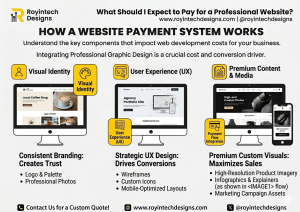
Why “Cheap” Often Becomes Expensive
Before we dive into numbers, let’s address the most common mistake South African business owners make: choosing the lowest quote.
A website priced at R500 might seem like a bargain, but what do you actually get?
-
A generic template with your logo slapped on
-
No mobile responsiveness (or broken on phones)
-
No SEO – so nobody finds you
-
No support after launch
-
You may not even own your domain or files
Therefore, a “cheap” site can end up costing you in lost customers and a costly redesign later. Smart budget planning means looking at value, not just the price tag.
What Determines the Cost of a Professional Website in South Africa?
Several factors influence the final cost. Understanding them helps you decide where to spend and where to save.
| Factor | Impact on Cost |
|---|---|
| Number of pages | More pages = more design and development time |
| Custom design vs template | Fully custom is more expensive but unique |
| E‑commerce functionality | Adds R3,000 – R10,000+ to the base price |
| Content creation | Copywriting and photography add R1,000 – R5,000 |
| SEO package | Basic SEO is often included; advanced campaigns extra |
| Agency vs freelancer | Agencies cost more but offer team backup |
| Timeline | Rush projects (under 2 weeks) often incur +50% fee |
Typical Cost Ranges for a Professional Website in South Africa (2026)
Here is a realistic breakdown based on quotes from reputable local agencies and freelancers.
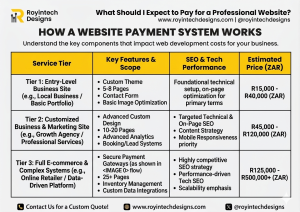
| Type of Website | Once‑Off Cost (Rands) | What’s Included |
|---|---|---|
| Basic business site (3–5 pages) | R1,500 – R2,500 | Custom design, free domain, 12 months hosting, basic SEO, contact form, mobile‑friendly |
| Standard SME site (6–10 pages) | R2,500 – R4,500 | All of the above plus blog, Google Maps, additional pages, Google My Business setup |
| Advanced business site (10–20 pages) | R4,500 – R8,000 | More complex layouts, galleries, landing pages, advanced SEO, booking system |
| E‑commerce website (online store) | R4,500 – R15,000 | Product management, payment gateway (Yoco/Payfast), shopping cart, inventory tracking |
| Custom corporate / high‑end | R15,000 – R35,000+ | Bespoke design, advanced integrations, dedicated project manager |
All these ranges assume you provide your own text and images. If you need copywriting or professional photography, add R1,000 – R5,000.
Hidden Costs – What Many Quotes Don’t Include
When comparing quotes, always ask what is not included. These are common extra costs:
| Hidden Cost | Typical Price | How to Avoid Surprises |
|---|---|---|
| Domain renewal (after 1st year) | R100 – R150/year | Ask if the first year is free, and what renewal costs |
| Hosting renewal (after 1st year) | R150 – R300/month | Many agencies include 12 months; confirm post‑year pricing |
| SSL certificate | R0 – R500/year | Most good agencies include free SSL (Let’s Encrypt) |
| Content writing per page | R200 – R500/page | Supply your own text to save |
| Stock photos | R50 – R300/image | Use free stock sites (Unsplash, Pexels) or provide your own |
| Ongoing maintenance | R250 – R1,500/month | Decide if you’ll manage updates yourself or pay a plan |
| Revisions beyond scope | Hourly rate (R300 – R800) | Agree on number of included revisions (typically 2–3 rounds) |
For example, a quote of R3,000 might seem fair, but if it excludes hosting after 3 months and charges R500 per extra revision, your real cost could be much higher.
How to Plan Your Website Budget – A Step‑by‑Step Approach
Use this simple process to create a realistic budget.
Step 1: Define your “must‑haves”
Write down the absolutely essential features. For a local tradesperson: home page, services, contact, gallery. For an online store: product pages, cart, checkout, payment gateway.
Step 2: Research 3–5 providers
Get quotes from freelancers, small agencies, and possibly a larger agency. Compare line items, not just totals.
Step 3: Factor in ongoing costs
Add first‑year hosting (if not free), domain renewal, and optional maintenance.
Step 4: Add a 15–20% contingency
Unexpected changes happen. A buffer keeps you stress‑free.
Step 5: Decide on DIY vs professional
If your budget is under R1,500, consider a builder like WordPress + a premium theme (cost ~R300). If you need lead generation and credibility, invest in a professional.
Agency vs Freelancer vs DIY – Which Is Right for Your Budget?
| Option | Upfront Cost | Pros | Cons |
|---|---|---|---|
| DIY (WordPress + theme) | R300 – R1,000 | Lowest cost | Time‑consuming, steep learning curve, often amateur result |
| Freelancer | R1,500 – R5,000 | Affordable, personal | May disappear, limited backup |
| Small agency | R3,000 – R12,000 | Team support, reliable, includes SEO | Higher cost |
| Large agency | R15,000+ | High‑end results, full service | Expensive for most SMEs |
For most South African small businesses, a professional freelancer or a small local agency offers the best balance of quality and price.
Examples of Real Website Budgets (South African Businesses)
| Business Type | Location | Pages | Total Once‑Off Cost | Monthly Ongoing |
|---|---|---|---|---|
| Hair salon (basic) | Randburg | 5 | R1,800 | R0 (self‑manage) |
| Plumber (SME) | Edenvale | 8 | R2,500 | R250 (maintenance) |
| Boutique (e‑commerce) | Fourways | 15 + 50 products | R8,500 | R350 (hosting + security) |
| Law firm (corporate) | Sandton | 20 | R12,000 | R500 (support + SEO) |
These are actual ranges from projects we’ve completed.
How to Get an Accurate Quote – Questions to Ask
When requesting quotes, use this checklist to ensure you’re comparing apples with apples.
-
“Is this a custom design or a template?”
-
“Do I own the domain and website files after completion?”
-
“How many rounds of revisions are included?”
-
“What is the cost for hosting after the first year?”
-
“Is basic SEO included? What does it cover?”
-
“What is your policy on post‑launch support?”
-
“Can you provide a fixed, itemised quote with no hidden fees?”
A confident provider will answer every question clearly. Vague responses are a red flag.
Saving Money Without Sacrificing Quality
You can reduce costs without ending up with a poor website. Try these proven tips:
-
Provide your own content – Write your own text and take high‑quality photos (modern phones are fine).
-
Use free stock images – Unsplash, Pexels, and Pixabay are excellent.
-
Limit page count to what you truly need – You can add pages later.
-
Avoid custom illustrations or animations – These are expensive and often unnecessary.
-
Choose a simple CMS (like WordPress) instead of a custom‑built admin panel.
-
Agree on a realistic timeline – Rush fees are avoidable.
In addition, paying a 50% deposit and 50% on completion is standard. Avoid agencies that demand 100% upfront.
Conclusion & Next Step
Choosing the right e‑commerce partner is one of the most impactful decisions you’ll make for your online business. By focusing on local expertise, verified portfolios, and clear communication from the start, you’ll find local web design agencies specializing in e‑commerce solutions that can truly deliver. If you’re ready to start building—or rebuilding—your online store with a team that understands your local market, book a free consultation with RoyinTech Designs today. Let’s create an e‑commerce experience that grows with your ambitions.